Why Solo Practice Works
We've all been there. You have the itch to play, the weather is perfect, but the group chat is silent. Instead of seeing this as a missed opportunity, view it as the ultimate chance to improve. Solo pickleball practice isn't just a backup plan; it's a secret weapon used by pros like Ben Johns and Anna Leigh Waters.
When you practice alone, you get thousands of touches on the ball in a fraction of the time it takes during a game. You eliminate variables and can focus entirely on your mechanics, footwork, and consistency. Whether you are working on your third shot drop or your hand speed, solo drills give you the repetition needed to build true muscle memory.
Pro Tip: Volume is King
In a typical 15-minute doubles game, you might hit the ball 30-40 times. In 15 minutes of wall drilling, you can easily hit 500+ shots. That's a 10x efficiency gain for your muscle memory.
The Wall: Your Best Practice Partner
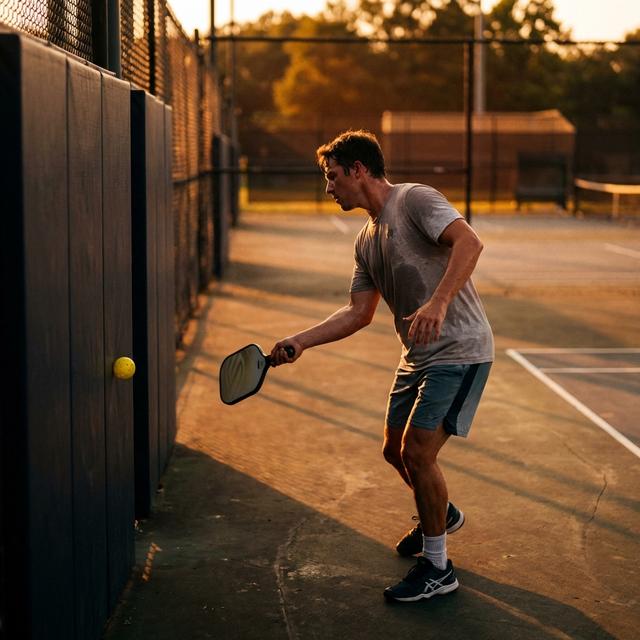
If you have a wall and some concrete, you have a pickleball court. Wall drills are the bread and butter of solo practice. The wall never misses, never gets tired, and forces you to react faster than a human opponent because the ball returns instantly.
Setting Up Your Wall
To make your practice effective, you need to simulate realistic net heights. Use some chalk or tape to mark a line 34 inches from the ground (center net height) and another at 36 inches (sideline height). Ideally, add a "kitchen line" marker on the ground 7 feet back from the wall.
Zone A: The Kitchen Line
Distance: 7 feet from wall
Focus: Dinking, resets, soft hands.
Goal: Keep the ball trajectory low and controlled.
Zone B: The Transition Zone
Distance: 10-12 feet from wall
Focus: Volleys, blocks, speed-ups.
Goal: Reaction time and paddle positioning.
Zone C: The Baseline
Distance: 20-22 feet from wall
Focus: Drives, drops, serves.
Goal: Power, spin control, and depth.
If you are serious about your wall practice, having the right paddle is crucial to prevent fatigue. Check out the Gamma 412 Bundle if you need a durable paddle that can handle concrete scrapes, or explore our 2025 Buying Guide for more options.
Solo Dinking Drills
Dinking is the art of patience. Solo dinking helps you develop the soft touch required to win at the highest levels.
Forehand-Only Dinks
Stand 7 feet from the wall. Hit continuous forehand dinks above the tape line. Focus on minimizing your backswing - think "push" not "hit". Aim for 50 consecutive shots without a mistake.
Backhand-Only Dinks
Repeat the process with your backhand. Most players struggle here. Keep your wrist firm and use your shoulder to guide the ball. The wall will expose any weakness in your grip stability immediately.
Alternating Figure-8s
This is the advanced level. Hit a forehand, move your feet, hit a backhand. Try to place your shots slightly to the left and right, creating a V-shape pattern on the wall. This forces you to shuffle your feet, simulating real kitchen play.
Volley & Hand Speed Drills
Want "fast hands"? The wall is the best trainer. By standing closer (about 4-5 feet), the ball returns faster than it ever would in a game, forcing your brain to process visual information quicker.
| Drill Name | Target Hits | Focus Area |
|---|---|---|
| Rapid Fire Volleys | 20 in a row | Reflexes & Compact Swing |
| The "Clock" Drill | 10 rounds | Directional Control |
| Squat Volleys | 2 sets of 15 | Leg Endurance & Low Balls |
For rapid fire drills, ensure you are in a ready position with your paddle up. If you struggle with reaction time, you might be using a paddle that is too head-heavy. Consider looking at reviews for balanced paddles like the CRBN 1X Power Series which offers excellent maneuverability.
Serve Mechanics & Precision
You don't need a wall for this one - just a bucket of balls and an open court. The serve is the only shot in pickleball you have 100% control over.
Target Practice
Place cones or water bottles in the deep corners of the service box. Practice hitting deep serves that land within 2 feet of the baseline. Depth is more important than power for beginners.
Spin Serves (Chainsaw & Topspin)
Once you have consistency, work on adding topspin. Brush up on the back of the ball aggressively. To understand how spin works scientifically, check out our guide on Mastering Pickleball Spin.
If you really want to dial in your serve mechanics without chasing balls all day, consider investing in a ball machine. The Titan Ace Pickleball Machine is a fantastic investment for serious solo players, allowing you to rep thousands of returns or serves efficiently.
Footwork & Shadow Swings
Pickleball is played from the ground up. You can have the best hands in the world, but if your feet are slow, you won't reach the ball.
Shadow swinging involves moving through the motions of a game without a ball. Visualize a rally. Split step. Shuffle to the right. Hit a forehand dink. Recover to center. This connects your brain to your body movement patterns.
Also, verify your footwear. Running on courts with improper shoes leads to injury.Nike Zoom Challenge shoes are specifically designed for the lateral movements required in these drills.
Essential Gear for Solo Training
While you can start with just a paddle and ball, a few tools can 10x your practice efficiency.
- 1. Ball Machine: The ultimate luxury. See our Titan Ace Review.
- 2. Ball Tube/Collector: Saves your back from bending over 100 times.
- 3. Consistency: Structure beats motivation. Set a regular practice schedule and stick to it.
Sample 30-Minute Routine
Don't just hit aimlessly. Follow this circuit for a killer workout.
The "Lone Wolf" Workout
Warm Up (5 Mins)
• 2 mins Shadow Swings
• 3 mins Light forehand wall dinks
Hand Speed (10 Mins)
• 5 mins Rapid fire volleys (Forehand)
• 5 mins Rapid fire volleys (Backhand)
Precision (10 Mins)
• 5 mins Figure-8 dinks
• 5 mins Target serving
Cool Down (5 Mins)
• Light stretching
• Review mechanics in mirror
FAQs
Q: Can I use outdoor balls for wall drills?
Yes, but they might crack faster on concrete walls. Indoor balls are often softer and last longer for wall practice, though the bounce is slightly different.
Q: How often should I practice solo?
Even 15 minutes, 3 times a week, will produce noticeable results in your hand speed and consistency within a month.
Q: Will wall drills mess up my depth perception?
They can if you *only* do wall drills. The wall returns the ball faster than a human. Mix in serve practice on a real court to maintain your sense of depth.
The Final Verdict
Solo practice is the separator between good players and great players. It shows dedication and allows you to refine the micro-skills that get lost in the chaos of occasional play. Whether you are using a high-end machine or just a garage wall, the key is consistency.
Commit to the "Lone Wolf" routine for two weeks, and watch your partners asking what your secret is during your next doubles match. The court is calling - even if you are the only one on it.
For more tips on strategy, don't forget to read our guide on Pickleball Tips and Tricks.