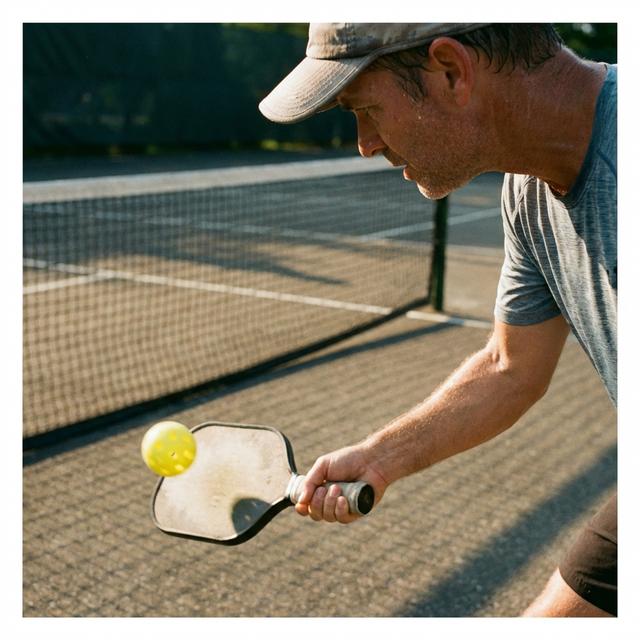
The "Banger" Problem
We've all been there. You hit a return that's a few inches too high. You start moving forward, and suddenly, your opponent unloads a drive that feels like it's breaking the sound barrier. You panic, stick your paddle out, and the ball sails five feet out of bounds or pops up for an easy smash. Game over.
In 2026, the game is faster than ever. Paddle technology with raw carbon fiber and power cores has turned intermediate play into a firefight. If you can't handle speed, you can't win.
But here's the secret: Power is useless if you can absorb it.
The "Reset" is the great equalizer. It is the shot that takes a 100mph drive and drops it harmlessly into the kitchen, forcing your opponent to scramble forward and hit up. It turns their offense into your opportunity.
💡 Pro Reality Check
Watch Ben Johns or Anna Leigh Waters. They don't win because they hit harder than everyone else (though they can). They win because they refuse to die in the transition zone. They reset the ball until they earn the right to attack.
What Exactly is a Reset?
A common misconception is that a reset is just a block. It's not. A block is defensive; a reset is neutralizing.
When you block a ball firmly, it often goes back fast. If you're out of position, returning a fast ball with a fast ball just gives you less time to recover. A reset takes the paceoff the ball. It lands softly in the non-volley zone (the kitchen), forcing the rally to "reset" to a neutral dinking game.
Shot Selection Dashboard
Result: High-risk pop-up or baseline drive.
Result: Unattackable drop into the kitchen.
Result: Potential winner or wide out.
Technique: The Soft Hands Revolution
Mastering the reset isn't about strength; it's about relaxation. The biggest mistake 3.5 players make is gripping the paddle like they are hanging off a cliff.
1. Grip Pressure: The Scale of 1 to 10
If 10 is squeezing the paddle until it breaks, and 1 is dropping it, you need to be at a 2 or 3 for a reset.
When the ball hits your paddle, a tight grip acts like a trampoline-the ball bounces off instantly with speed. A loose grip absorbs the energy. The paddle should slightly recoil in your hand upon impact.
Tactical Grip Pressure Gauge
2. Paddle Angle: Open the Face
Paddles like the LUZZ Pickleball Paddle, with their gritty T700 Carbon surfaces, love spin. But for a reset, spin is secondary to angle.
You must open the paddle face slightly towards the sky. If your paddle face is vertical (flat), the ball will go straight back into the net or too deep. By opening the face, you use the incoming speed to lift the ball gently over the net.
3. Minimal Movement
Stop swinging! A reset is a absorptive shot. You "catch" the ball with your strings/face. Your paddle should move very little. Think of it like bunting in baseball, but even softer. Let the opponent's power provide the energy.
Surviving the Transition Zone
Also known as "No Man's Land," this is where points are lost. You hit a third shot dropthat's a bit high, and you're stuck mid-court.
The Golden Rule: Do not move your feet while hitting.
Many players try to run forward while resetting. This impacts your stability and depth perception.
- Split Step: As soon as your opponent is about to hit, STOP.
- Set Base: Feet wide, paddle out in front (backhand favored).
- Reset: Absorb the drive. drop it in the kitchen.
- Move: ONLY after you see the ball dropping safely, then advance.
If your reset is poor (too high), do not move forward. Stay back, hold your ground, and try again on the next ball. You only earn the right to move to the kitchen line when you hit a good shot.
Gear Check: Does Your Paddle Help?
While technique is 90% of the battle, gear matters in 2026. If you are using a 13mm power paddle and struggling with resets, you are making life hard for yourself.
Thicker core paddles (16mm+) are universally better for resets because the thicker core absorbs more impact energy.
Our Top Picks for Control & Resets:
- LUZZ Pickleball Paddle:The T700 carbon fiber face is exceptionally soft, and the polypropylene honeycomb core is a vibration dampener. It mutes the ball, making "soft hands" easier to achieve naturally.
- CRBN 1X Power Series 16mm:Don't let the name fool you. The 16mm core provides incredible stability on blocks. If you hit off-center in the transition zone, the CRBN 1X is forgiving enough to still get the ball over.
Tip: If your paddle feels too "poppy," try adding lead tape to the throat (bottom sides). This increases the twist weight and stability, making the paddle less likely to wobble on hard drives. Check our Paddle Tech 2026 Guide for more on swing weights.
3 Drills to Master the Reset
You can't learn this in a game. You must drill it.
1. The 7-11 Drill (Transition)
Player A stands at the Kitchen Line (acting as the Banger). Player B stands in the Transition Zone (mid-court).
The Goal: Player A hits firm drives at Player B's feet. Player B must reset the ball into the kitchen.
Scoring: Player B gets a point for every reset that lands in the kitchen and prevents Player A from hitting a downward smash. Play to 11. Switch roles.
2. The "Hot Hands" Wall Drill
Find a wall. Stand 5 feet away. Hit the ball hard at the wall, and try to reset the rebound softly to yourself before hitting it hard again.
Pattern: Drive -> Reset -> Drive -> Reset.
"Hot Hands" Drill Visualizer
Hit the wall hard. Mimic a banger's attack.
TENSIONLoose hands. Let the ball die on your paddle.
RELAXATIONGently hit the ball back to the wall at a dink pace.
CONTROL3. Skinny Singles Resets
Play skinny singles (using only half the court). The rule is: You are NOT allowed to drive the ball. You can only drop, dink, and reset. This forces you to navigate the transition zone without bailing out by just banging the ball back.
The Mental Shift
The hardest part of the reset is the ego. When someone smashes the ball at you, your instinct is to fight back. "You want to hit hard? I'll hit harder!"
Resisting that urge is what makes you an advanced player. Resetting a smash is a power move. It tells your opponent:"Your power doesn't scare me. In fact, it's useless here."
Staying calm under pressure is what separates intermediate from advanced players. Focus on your breath and trust your training.
The Final Verdict
The reset is the bridge between defense and offense. It is the survival tool of the transition zone. By loosening your grip, opening your paddle face, and trusting the physics of absorption, you can neutralize even the hardest hitters at your local court.
Remember: Bangers hate dinkleball. They want chaos. The Reset restores order.
Grab a control paddle, find a drilling partner, and start embracing the soft game. See you at the kitchen line!